

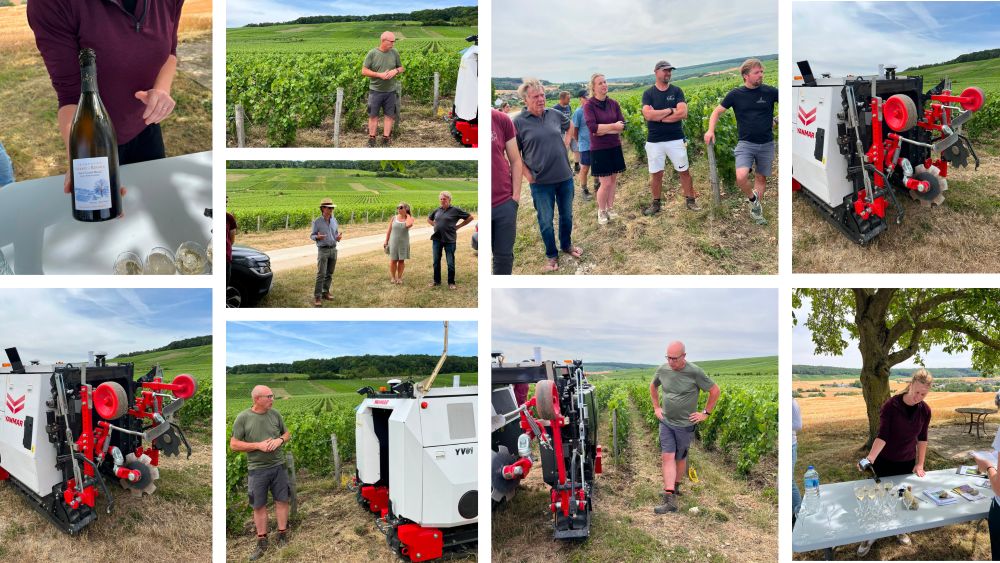
🍇 Laurent Liébart welcomed us at the foot of his vineyards for this latest ‘Vigne Bio Ouverte’ event. Having switched to organic farming, he explains that this transition was driven by concerns over water quality 💧, a topical issue for local authorities. Many water catchments in France contain high levels of metabolites from banned herbicides, leading to more complex and costly water treatment processes.
🌱 In Champagne, Laurent points out that the quality reserve acts as a real ‘lifeline’, enabling the vineyard to compensate for a poor harvest and to make the transition to organic farming with confidence.
🌍 He presented the terroir of the Marne Valley, characterised by clay soils that are demanding and sensitive to frost. Tillage, which is essential for controlling plant vigour, is carried out in three stages: disc harrows in March, a hydraulic plough in April, followed by alternating between a hydraulic plough and a sensor plough 🚜.
💧 Water quality is a key factor in optimising the effectiveness of treatments: pH, conductivity, trace elements, etc. The aim is to achieve a water pH of between 5.5 and 6.5. Whey helps to naturally acidify the water. Data from the ARS and ANSES provide valuable guidance for adapting spray mixture preparation protocols.
🧪 Timothy Bolander, an American researcher based in Champagne, is developing a fertilisation approach based on the analysis of trace elements present in the sap. In his view: “It is not the soil that nourishes the plant, but the plant that nourishes the soil.” NovaCrop Control analyses measure around twenty parameters (pH, sugars, potassium, calcium, magnesium, etc.). Boron, which is essential for flowering, is very immobile; calcium is often deficient despite its presence in the soil.
He also points out that during hot spells, ☀️ the vine can break down its own proteins, increasing the ammonium levels in the sap, which opens up a field of research into the sugar/protein balance and root exudates. 🌱
🤖 The VBO concluded with a demonstration of the YV01 (Yanmar) autonomous crawler tractor, the estate’s latest acquisition. The machine can be fitted with various attachments, including a sprayer classified as 2–3 (Sprayer Performance Index). 💶 The investment amounts to €128,000 excluding VAT, with an annual cost of €3,000 excluding VAT for the RTK GPS. An IPAGE regional grant, of up to €30,000, is currently under review.
⚠️
The robot requires the presence of an observer for regulatory reasons. Laurent noted a few limitations, notably the detection of tall weeds, which are treated as obstacles.
🥂 The afternoon ended with a wine tasting under a majestic walnut tree, featuring the cuvée made from the Meunier grapes grown on the plot we visited.
🙏 Thank you to Laurent and his daughter for their hospitality, and to Timothy for his scientific insights.