

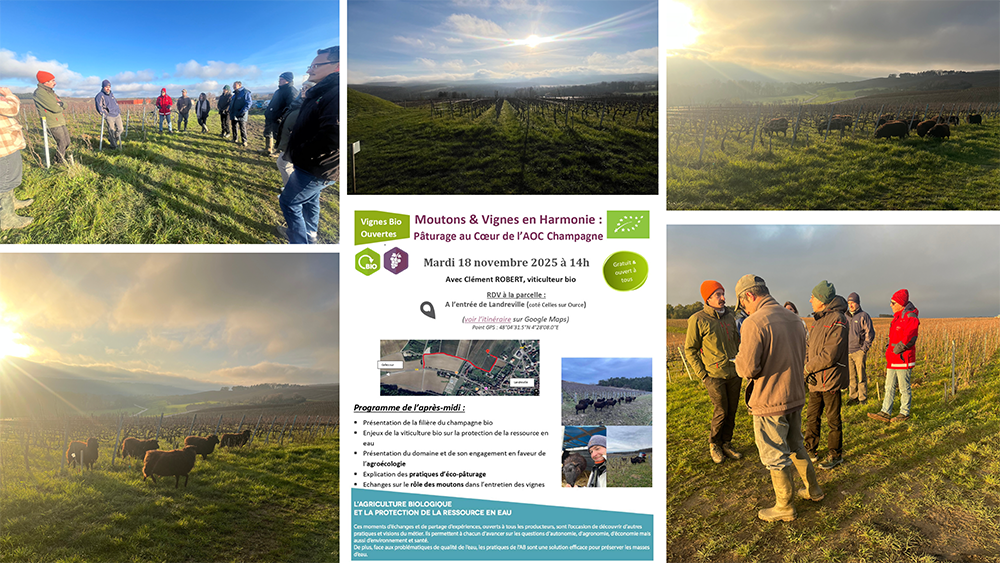
Based in Landreville, Clément Robert took over the estate in 2019 and embarked on a major transition towards organic viticulture 🍇: organic certification obtained in 2022, and sheep grazing introduced in the vineyards.
Since November, 14 sheep — two castrated males and ewes — have been grazing his plots. They are mainly breeds suited to vineyards, such as Landes de Bretagne and Ouessant, which are hardy, robust and ideal for soil maintenance. Clément invested just under €7,500 💶 for all the equipment and the flock.
The sheep graze around 4 to 5 hectares per year 🌾: they stay in the vineyards all winter ❄️, leave in April 🌸, then return around September 🍂. A communal shearing ✂️ is organised every year in May, in collaboration with other winegrowers in the area who also have sheep.
Clément has never had any problems with sheep escaping or being stolen. The key is good fence management and organisation, mainly logistical. He is also planning to install a permanent fence to make grazing even easier.
Here are a few essential points he shares:
• Avoid introducing sheep too early ⏰ so as not to encourage excessive regrowth 🌱.
• Sheep do not like tall grass 🌿: it is crucial to intervene at the right time.
• Never put them in immediately after adding compost ♻️.
• Grazing must remain precise and consistent: plots that are too large result in uneven grazing.
• Unlike sheep, pigs 🐖 require more stringent regulatory constraints (double fencing, greater risk to vines).
• Goats 🐐, meanwhile, eat wood: incompatible with vines!
For Clément, this is not about livestock farming but sustainable grazing 🌿, which is perfectly compatible with the organic management of his vineyard 🌱: an inspiring model for reconciling biodiversity, natural maintenance and organic viticulture.
A big thank you to our member Clément Robert @domaineleon for his explanations! 🙏
@grandestbio